Some of us have seen instances where a new angler casts their line into the water only for them to pull up such a huge fish that they end up looking like a pro. But if we are being honest, these moments are few and far between. In fact, they are more common in the movies than they are in the open water. And that’s because in real life, the kind of fish you pull from the water is rarely a result of pure luck. Instead, it comes down to the prevailing factors that determine whether you are going home with a marlin, a perch, or absolutely nothing. In this guide, we explain the factors that shape your catch as well as the species that most anglers get to take home on a regular basis.
Did you know that the International Game Fish Association has a database with hundreds of recognized game fish species? From bass to trout, marlin, and tuna, there are hundreds to thousands of fish that anglers can target. Yet, you find that even with all these options, anglers tend to focus on the same fish so much so that the same names dominate the top 100 lists year after year. Well, why is that? Besides overall preference, anglers are subject to the following external influences:
Fish vary physiologically when it comes to aspects such as respiration, oxygen use, heat tolerance, muscle composition, movement, sensory systems, reproduction, metabolic adaptations, and more. All of these variations affect their ability to thrive under certain conditions, and this paves the way for differences in availability based on temperature.
In cold areas like Alaska, you find fish like salmon and halibut, as these are able to thrive in these low temperatures. But when you move to the hotter bodies of water, which tend to have lower oxygen availability, the species change, and you start coming across options such as bass and carp, which are well adapted to such conditions.
It is important to add that though regional differences dictate the types of species available to anglers, climate change is slowly changing this. We are now seeing an influx of fish species in regions where they were not previously available. Take the African Hind for example. In the past, this fish was mainly available in the warmer southern latitudes. But now, more anglers are sharing that they are getting hold of this fish as far up as the Mediterranean!
With open oceans, you find a wide variety of fish species because of the central connection to different water bodies, which paves the way for the mixing of species. However, in enclosed water bodies, such as the Great Lakes and the Amazon, you come across unique species that may not be available in the ocean. Examples include Peacock Bass and Muskellunge. As such, anglers who are keen on catching rare species tend to center on these solitary water bodies.
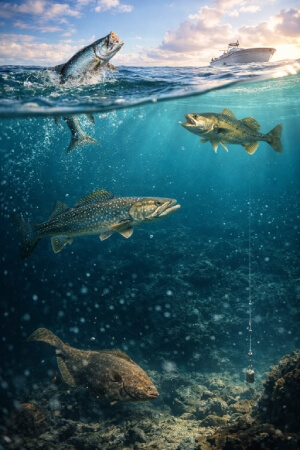
While all fish live in water bodies, they tend to take up space in different neighborhoods, which are characterized by different conditions owing to variations in the depth of the water. Even so, it is important to note that fish do not remain in one neighborhood for good and instead migrate from one neighborhood to another for purposes such as spawning and feeding. These neighborhoods are as follows:
Here, you find the types of fish that need a lot of sunlight and high oxygen levels. These species tend to have a high tolerance for changing temperatures and have great vision for hunting. Examples include tarpon and bass.
Deeper into the water, the light dims, and the temperature and oxygen levels fall. These conditions are great for fish with sensitive eyes, as well as those that are able to migrate upwards with ease. Lake trout and walleyes are some of the species you find here.
With very little light, limited oxygen, high pressure, and cold water, these conditions are ideal for species with slow metabolism and specialized swim bladders. These species also tend to rely more on their other senses instead of vision, and they include favorites such as halibut and grouper.
Anglers must know the neighborhood in which their target species lives, as this helps them with selecting the right gear, bait, and techniques. For example, when hunting fish from the deep water zone, anglers must change their techniques to avoid predisposing the fish to pressure damage, which happens when the pressure drops suddenly, resulting in the expansion of their swim bladders. If this pressure damage takes place, then catching and releasing is no longer an ethical option.
Fish don’t just take the bait and give in to anglers. Instead, they fight to live, and sometimes, they win! Now, the outcome comes down to the kind of gear you are using, the type of fish you are fighting, and whether you need people to have your back. How so?
When hunting endurance swimmers like tuna and marlin, you have to be ready to put up a fight. These fish have high concentrations of red muscle as well as specialized heat exchange systems, which allow them to process oxygen quite well while managing their lactic acid buildup. So, in the same way that they are able to migrate long distances, they can fight for hours without giving in.
On the other hand, when you are hunting burst predators like pikes and barracudas, the odds change in your favor. These species tend to have very high explosive power that enables them to sprint when they are caught. But if you can endure these strikes and stand your ground, these fish tend to get tired within minutes, allowing you to have the upper hand.
But not just these extremes exist. There is a middle ground where species, such as many reef fish, have both red and white muscle. So, they are able to put up a good fight while also sprinting fast.
Again, like with the water depth, the issue of ethics comes into the picture. If you are hunting to release the fish later, then you want to avoid getting into long tackles with the endurance swimmers because their lactic acid levels can build up so much that they can die even after you release them.
As you have noticed with big catches like Blue Marlin, Black Marlin, Yellowfin, and Bluefin Tuna, anglers tend to work in teams. And that’s because when you are angling for a 500-pound catch, you just can’t do it alone. So, what makes up a team? The makeup comes down to the kind of species you are targeting. But for the most part, teams have the following people:
By working as a team, anglers are able to catch more fish while staying safe, even as they come face-to-face with some of the most dangerous species.
Now that we understand why some anglers are able to take Alligator Gars home while others go for Halibut, let’s look at some of the most common game fish and why anglers gravitate towards them.
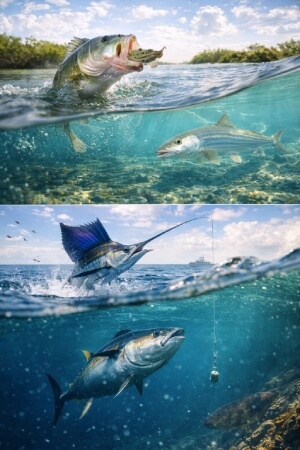
This fish’s mouth is true to its name, which makes for a great photo op. But anglers do not seek out these species just for the pictures. Instead, they love the hunt. Since these fish tend to be smart enough to recognize lures and even hit them with enough force to cause a splash, anglers end up having to strategize so as to determine where to strike based on factors such as cover, light, and water temperature. And if you catch one, it is proof that you outsmarted the fish!
With speeds of up to 110 kilometers per hour, these are some of the fastest fish you will ever come across. However, the challenge in catching these fish does not lie in their incredible speeds but rather their tendency to hunt in packs. You find that as you are trying to catch one, you end up hooking one or two more on the other lines, resulting in quite an intricate mess of dancing fish as you try to keep the lines from tangling. It is pure chaos, but the rewards are just as exciting.
These fish are so sought-after that the large ones rake in millions of dollars in auctions. So, what makes them so special? For one, they are avid fighters who can keep going for anything from one to five hours. That means that for anglers to have the upper hand, they must be willing to invest in high-quality gear and muster up the endurance required. Secondly, these fish are warm-blooded, which allows them to go deeper into the neighborhoods we earlier mentioned without risking damage. Anglers who are able to keep up with them and come out as conquerors are able to wear this feat as a badge of honor.
These fish are quite an enigma, if we may say so. You see, they are found in waters so shallow that you can literally see them from above. But catching them is much harder than it looks, as these fish are very good at spotting anglers. What’s more, they are very fast at moving away from perceived dangers. In fact, once you hook them, they run so fast that they can strip 100 yards of line in just seconds! For these reasons, anglers love adding bonefish to their list of catches, as they serve as a testament to their well-executed strategies.
These species rank as the most widely caught in the world. And that is because, unlike the unique fish we have covered above, these tend to be very accessible, not just in water depth but also in simplicity of the angling gear. You can even catch them with a cane pole! These species are often found in the shallows around weed beds and docks. And even though they put up a bit of a fight, keeping up with them is quite easy.
You can find these fish in most rivers and ponds around the world. And catching them is quite easy. Just by leaving out a smelly bait and waiting, you pave the way for the fish to come to you. Of course, nuances such as deep holes and river currents play a role in how successful you are, but once you have these down, then a large catch awaits you.
Not many fish can do well in both saltwater and freshwater, but striped bass is one of the success stories. But is catching them easy? Well, yes and no. On the upside, these fish tend to feed in large numbers, which improves your odds of catching them. On the downside, though, they are great at putting up a fight. While they may not jump when caught, they know how to put their heads down and use their large size to their advantage by pulling against the current.
These species are such light biters that it is quite possible to miss them when they take the bait. To add to that, they are well adapted to seeing in low light conditions, which makes it easy for them to spot anglers even when other fish cannot. But none of these factors deters anglers from seeking them out. After all, they are some of the tastiest freshwater fish, and most people will stop at nothing to catch them.
Trout (Rainbow, Brown, Brook), Salmon, and Tarpon are other common choices in the angling communities.