From the outside looking in, sport fishing and commercial fishing may look like one and the same thing. After all, they both focus on catching fish, right? And thanks to this similarity, many people end up grouping them together. But the truth is that they could not be any more different even if they tried. In this guide, we explain what differentiates them and go a step further in explaining the techniques you come across in sport fishing and how best to use them in your favor.
If you tell most people that you are going fishing, they will chalk your experience up to the same as going trawling in the ocean. But as any angler will tell you, sport fishing is a far cry from commercial fishing in the following ways:
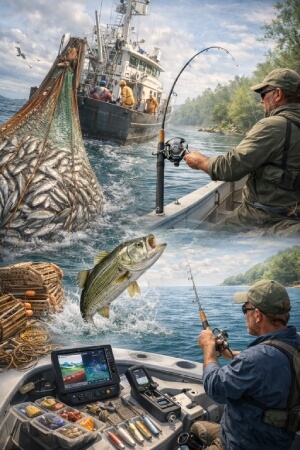
With commercial harvests, the goal is to provide food security while also turning a profit. Simply put, these are business ventures with bottom lines and everything that goes with that. As such, they focus on metrics such as market value, the tons of their catches, and all other figures that either raise or dent their revenues. But with sport fishing, people are in it for fun, competition, or even personal consumption. For the most part, anglers focus on the thrill of being in the outdoors, waiting for fish to take the bait, and reeling in their catches. And success here is not about the number of fish caught but rather the stories behind the catches or the sizes of the fish. You even find that most anglers throw their catches back into the water because they are not interested in taking them home.
Commercial harvesting is a multi-billion-dollar industry that supports processing plants, seafood stores, and a wide variety of other food systems. But does sport fishing have such a big effect? Why, yes! While anglers may not be providing food for homes across the world, they play a vital role in driving the service and tourism industries. People spend money on travel, hotels, fishing gear, and other products and services that allow them to experience fishing. And since several tourists can catch and release the same fish over a long time, sport fishing contributes a lot more to local economies than the plain catching and selling of fish in local and international markets.
Commercial harvesting businesses catch tons of fish at a time. And as such, they are more likely to make mistakes that can hurt the ecosystem in the long term. For example, with trawling, if the nets catch the wrong species, these often die even before the nets are on the deck, which makes it difficult for these businesses to throw the species back into the water. Because of these likely detrimental effects, these businesses are subject to strict rules such as seasonal quotas, total allowable catches, and bycatch mitigations to prevent the accidental capture of species such as turtles and dolphins. Since sport fishing takes place on a much smaller scale and anglers are able to note and rectify their errors fast, the regulations are a bit more relaxed, and they focus on things such as individual limits, fish size minimums, and ‘catch and release’ policies for endangered species.
With commercial harvesting, you encounter gear such as massive nets, longlines with thousands of hooks, and pots or traps. In addition to these tools, these businesses rely on the latest technology to track and process the fish, alongside highly organized crews. But sport fishing is not as intensive. If anything, anglers rely on the basics of rods, reels, tackle, and lures while working with fish finders and GPS to map and track the fish. So small are these ventures that many anglers go solo or with small groups of friends or family.
While anglers may not have trawling ships, they can adapt their fishing styles based on factors such as species, preferences, and environments in order to improve their chances of success. So, which options are available to them and how do they work?
Artificial lures can be easy to spot, and it is not uncommon for fish to avoid them entirely. To prevent the fish from catching on to their antics, anglers cast their lures into the water repeatedly in order to mimic prey like insects and frogs. This way, the fish strike at the lures, allowing the anglers to reel them in. This highly interactive technique works great for fish such as bass, pike, trout, and many saltwater species.
When anglers are out to catch trout, salmon, bonefish, tarpon, and other species that can easily note changes in the water, they turn to fly fishing. In this case, the flies feature light materials like fur and feathers that allow the anglers to cast their lures without spooking the fish. In most cases, anglers fish this way while wading in the water, which creates a very immersive experience.
Since the fish in the open ocean are always moving, trolling serves as the best way to catch them because it enables anglers to keep their lures in the water as the boat moves. By creating the illusion of a fleeing tuna or squid, these lures trigger predators to chase after them. This technique allows anglers to appeal to the fish that live in the upper layers of the open sea, such as marlin, tuna, and sailfish. And often, it results in the catching of fish that are several hundred pounds heavy.
Most fish species do not live in the open ocean and instead choose to live in the structures below, where they can find food and protection. Bottom fishing allows anglers to reach these hidden species by dropping their lines directly into structures such as coral reefs, rock ledges, and shipwrecks. Given the high concentration of fish in these spots, anglers are almost always assured of a bite with every drop they make. And with options like Grouper, Snapper, Halibut, Cod, and Sea Bass for the taking, many anglers who are after tasty edible fish choose this technique time and again.
Angling is all about working with nature, rather than against it, especially when working with wary fish. And drift fishing is a testament to this. Here, anglers cut off the motor and allow their baits to move with the currents, just like organic matter or actual injured fish. And thanks to the lack of tension in the line, this drift signals that the bait is not a trap, such that when it reaches the strike zones of species like Permit or Yellowtail Snapper, they go for it.
While drifting is all about the waiting game, jigging is designed to trigger the ‘chase and kill’ reflexes in predatory fish. How? Well, anglers jerk their lures so much in the water that they imitate fleeing baitfish. And since these lures feature glow-in-the-dark or holographic features, they look like the scales of a dying fish as they flutter and dart in the water. Once convinced, the predatory fish come in for the kill, even if they may not be hungry, and that is how anglers get the upper hand.
Even without specialized boats, anglers are able to fish beyond the breaking waves through surfcasting. This technique relies on huge rods that measure 10 to 15 feet, which allow anglers to launch their lures or baits over 100 yards into the ocean. Thanks to this coverage, they can attract species like striped bass, bluefish, and red drum. Of course, succeeding in this technique requires a good knowledge of channels and reading the water. But its ruggedness is a huge perk as it allows anglers to fish from anywhere and at any time.
While anglers often base their choice of fishing technique on preferences, their decisions often boil down to the prevailing factors. But which are they?
Every fishing spot is different, and anglers must thus choose their gear based on the unique characteristics of each region, as follows:
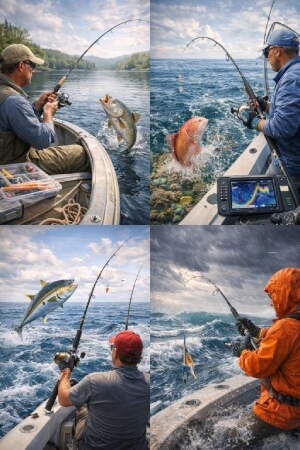
Freshwater and saltwater environments call for different gear and techniques because they boast different species and ecosystems. In freshwater bodies, such as lakes and rivers, anglers target species like bass or trout, which are easier to catch with the use of light tackle. But with saltwater bodies, such as oceans and bays, the fish are much larger and stronger, and the gear has to be as heavy. So, you find that most anglers opt for bottom fishing, trolling, and other techniques that can handle the heft of the species.
When anglers are navigating fishing spots such as reefs and wrecks, they rely on bottom fishing as it allows them to target these species right in their habitats. However, with open waters where fish like tuna and marlin are found, it is not easy to catch the fish as they are always on the move. So, anglers go for techniques like trolling, which allow them to cover large areas and thus increase their chances of success.
Anglers know that seasonal changes have an impact on fish migration and feeding habits, as does the weather. Take calm versus rough days, for example. On days when the seas are calm, trolling is easy because the lures are able to move smoothly enough to get the attention of fast predators. But on the days when the conditions are rough, techniques like jigging and drifting work better because they mimic the natural turbulence of the water.
You find that most anglers tend to zero in on a specific species when they are going out into the water. So, does this affect their techniques? Absolutely. Species impact fishing techniques due to the following factors:
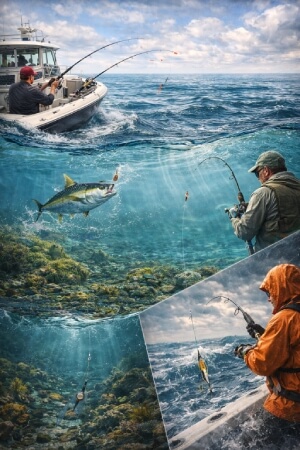
Fish vary in their movements, habitats, and more. As such, anglers must choose fishing techniques that best fit their targets. Take pelagic fish, as an example. These live in the upper layers of the ocean and are prone to roaming. Therefore, when targeting these fish, anglers go for trolling as it encourages these species to move towards the perceived prey. But when hunting demersal species, which live in the bottom layers, anglers find that these species do not move around as much and are therefore easy to catch with methods such as bottom fishing.
When targeting opportunistic feeders, anglers use live bait drifting as it makes the prey look real and effortless. So, species that love ambushing their prey go for these types of bait. However, when anglers are hoping to catch predatory fish, they have to be more aggressive with their approaches, which is why they use techniques like trolling and jigging, as these create opportunities for these predators to chase and strike.
Culture does not just affect how people dress and eat. It also seeps into how they fish, which is evidenced by the different angling techniques per region due to the following factors:
Many regions rely on fishing techniques that have been practiced for several generations. For instance, in regions with a high population of baitfish, you find that anglers prefer using live bait drifting. But when you move towards regions where pelagic species are in high numbers, you find that trolling is the norm. And since people tend to conform to the norm, every region tends to have its specialty, with a few outliers here and there.
With more regions becoming more aware of the impact of fishing on ecosystems, regulations have since changed, and this has played a role in the techniques in use. Along this line, regions with sensitive reefs have banned or restricted bottom fishing. Additionally, during spawning seasons, most regions restrict trolling.
Beyond complying with the local rules, more anglers have their sights set on conserving the ecosystems and have thus moved towards techniques that cause the least harm to fish. Nowadays, many anglers go for barbless hooks, circle hooks, and other tools that enable them to enjoy the thrill of fishing while leaving them room to release the fish back into the water, unharmed.