What sport fishing is about? Did you ever ask yourself? When it comes to it, many might believe it’s all about luck. Fortunately, that’s not exactly how it goes, and certain aspects can significantly increase your chances of success. Not only the way you fish matters. The place where you fish is as important.
What fails in deeper areas might work in shallow water. It appears to be difficult, and it’s totally understandable that you wish for simplification. That is why we will explain the most common sport fishing methods and dive in on how, when, and why to use them.
Fish react differently depending on their mood. Sometimes they chase moving prey. Sometimes they stay close to the bottom and feed slowly. If the technique does not match the situation, even the best location will not produce results.
Fishing technique means how you show the bait to the fish. To be honest, there are quite a few strategies out there, and each comes with its own specialities. While some techniques are fast and active, others are slow and quiet. First things first, let’s take a look at the fishing methods.
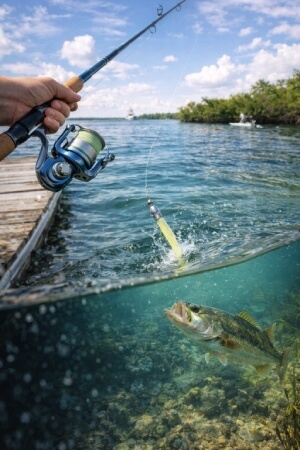
Spinning is not the only method, but it is one of the most popular fishing methods. The reasons are simple:
This method uses a spinning reel mounted beneath the rod. Spinning allows for accurate casting and works well from shore, boats, and piers. You can cast artificial or natural baits and retrieve them at varying speeds.
Spinning fishing is the right method when fish are actively feeding near the surface or mid-water. By adjusting lure size, color, and retrieve speed, anglers can adapt quickly to changing conditions, which goes for newcomers too.
Typical targets are bass, trout, pike, perch, and many coastal saltwater species.
Love tradition? Then fly fishing is the right thing for you. This method is both a technique and a craft. Instead of casting the weight of a lure, anglers use the weight of the fly line to present lightweight artificial flies.
Fly fishing works very well during insect hatches. At this time, fish focus on one specific type of food. They ignore most other things in the water. That is why fly fishing is often used on rivers and streams.
The main goal in fly fishing is a natural look. The fly should move like a real insect or a small fish. This takes good timing and careful movement. Anglers must watch the water closely. To choose the right fly, they look at what insects are active. They also pay attention to the current and how fish react. Observation is just as important as casting skill.
Baitcasting uses a baitcasting reel mounted on top of the rod. When targeting fish near rocks, submerged trees, or docks, this might be your top fishing method. It allows you to place the lure precisely at the same time it allows heavier lines and lures, making it valid for strong, aggressive fish species.
Baitcasting offers superior control once mastered, so it’s worth a try. It is usually used in freshwater fishing, especially for larger predators.
The bait is presented directly on the bottom using weights to hold it in place. This method is commonly used in saltwater but is also effective in lakes and rivers. Bottom fishing targets fish that feed on the seabed, lake floor, or near it. Bottom fishing is top-notch for anglers who want to fish slower and have more patience when fish are inactive.
Jigging uses vertical or short-range movements. A weighted lure known as a jig is mimicking the injured prey. Jigging can be fast and aggressive or slow and subtle; it all depends on the species and conditions. It is particularly effective in deeper water where precise depth control is needed.
Here is a clear comparison for you:
| Category | Bottom Fishing | Jigging |
|---|---|---|
| Presentation | Bait stays directly on or very close to the bottom. | Lure moves vertically through the water. |
| Movement | Mostly passive with little action. | Active and controlled by the angler. |
| Main trigger | Fish react to scent and natural bait. | Fish strike due to sudden movement. |
| Best situation | When fish are inactive or holding deep. | When fish respond to motion. |
| Effort level | Requires patience and waiting. | Requires constant rod movement. |
| Depth control | Weight keeps bait in place. | Depth is controlled by lift and drop. |
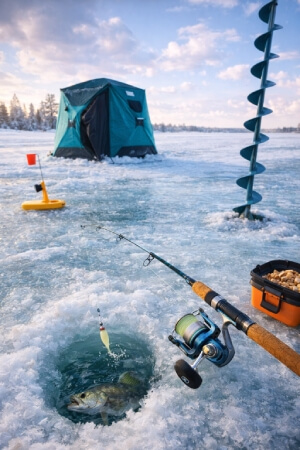
Ice fishing takes place on lakes and rivers, but here it comes: they are completely frozen. That makes it challenging to find the spots where fish gather. Once you are sure about the spot, you drill holes through the ice and fish straight down. Short rods or simple rigs are often used, and movement is limited. Here is what you should bring on an ice fishing trip:
With this technique you have only one way: knowing where fish stay during winter. While it gets cold, there are many species which slow down. Then they gather in deeper areas.
This must be said! Safety is number one in ice fishing. Ice thickness shall always be checked. Proper clothing is required. Ice fishing is seasonal and needs planning, but it can be very effective when done right.
To reach out beyond the breaking waves anglers use long rods. The chance to have the fish just behind the wave, looking for food, is bigger than you might think. For surf fishing you won’t need a boat, all you need is the beach.
Fish often feed in deeper channels surrounded by sandbanks. Unfortunately, these channels are not always easy to see. Take a deep look at wave patterns, the lightness of the water or calmer spots. Here you might be able to see the fish moving.
If you want to jump into surf fishing, patience is one of the must-haves. Fish may not bite straight away, still the game is not lost. Timing can change everything. Also, success is up to tides, wind, and light.
Overwhelmed? Well, there are a few more techniques that you should know about. Let’s speak about the ones that are not on the top list but also can help you to become successful in fishing.
In Trolling you are sitting on a boat that pulls lures or bait behind at a steady speed. That’s the right method, when you aren’t really a patient person. By that way you can cover a large area of water in a short time.
There are two things that can’t be forgotten which are depth and pace. Not all the fish stays at the same level of depth. Some are waiting down, others stay near the surface. In order to reach the right level of depth, you have to adjust line length. Another way could be to use weights. Let’s say you are on the run for fish like salmon, trout and walleye, then trolling fishing is a strategy you shouldn’t miss out on.
Bow and spear fishing are direct and physical methods, meaning you don’t use a rod or a reel. No, you will shoot or spear the fish. For bow fishing you will find yourself in shallow water, many times at night with strong lights. Thanks to the light, you can see fish near the surface. To be able to pull the fish back after the shot, you need a special bow.
Spear fishing is often done while diving. Always around rocks, reefs or plants, this is where you can find fish most of the time. So you look for them there and the rest is just about breathing calmly and aiming well.
No wind, no kite fishing, but too much wind creates problems of control. Therefore, it’s mostly used in saltwater, especially offshore. A kite is flown from a boat, and the fishing line is attached to it. The bait hangs on or just above the water surface. Wind keeps the bait in position without the boat moving too close.
Fish that feed near the surface are the target. Because the bait stays almost weightless, it simply looks natural. When a fish strikes, the line releases from the kite clip and the fight begins.
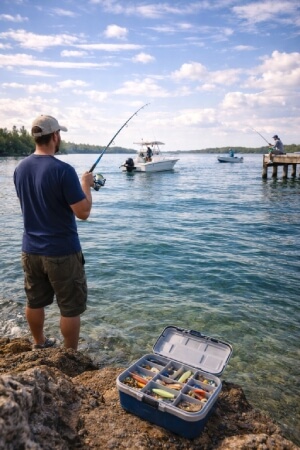
Choosing the proper fishing technique is not about using the “best” method. Unfortunately, there is no “best.” It is simply about using the method that fits you, the water, and the situation. Many anglers start with one sport fishing technique and slowly add more over time.
The following points help narrow the choice realistically.
The right technique is a personal process that can’t be rushed. Over time, you’ll naturally find what suits you best.
Sport fishing techniques make it possible to pick out many options. Yes, that might make it harder to choose, but no single method works all the time or in every place. Conditions change, and fish may react differently today than yesterday.
Learning several methods helps you stay flexible. With experience, it definitely becomes easier to know when to slow down, when to fish deeper, and when to switch methods, but it can be studied.
Fishing becomes more fun if technique, conditions, and timing come together as one. That balance is what keeps anglers learning and improving over time.