The sport fishing opportunities you enjoy today were created by past generations who made good decisions. They carefully released fish when there was no need to keep them, respected rules even when no one was watching and helped to protect the places we love to fish.
We should not underestimate the importance of this work. The sport fishing opportunities available to future generations will depend on the actions we take now.
Conservation and good angling practices contribute to healthy sport fishing – rather than limit our ability to enjoy it.
Good sport fishing is based on solid ground – protecting marine habitats, working to understand and manage fish populations and following good fishing practices while out on the water. This guide walks you through everything you need to know about sustainable sport fishing.
Sport fishing is not a niche hobby. The US Fish and Wildlife Service reports approximately 54 million American anglers. This significant presence in aquatic ecosystems, from fishing just twice a year to catching something twice a week, means all anglers have a role to play in maintaining healthy fisheries.
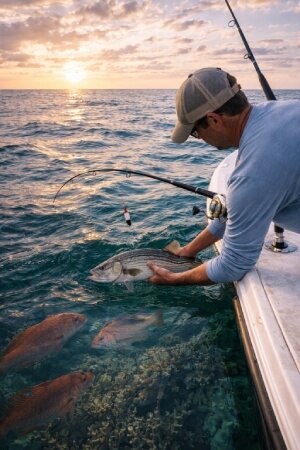
Data from NOAA Fisheries reveal that for certain species, recreational catches are equal to or surpass commercial catches. Red snapper and striped bass serve as prime examples. With millions of anglers making their own fishing decisions, the cumulative contribution to fish population conservation efforts is substantial.
It is not a criticism – it is a reason why anglers can create positive change. The fact that sport fishing presents challenges means we also have the capacity to deal with issues surrounding it. Sustainable sport fishing starts with acknowledging the individual actions that contribute to its success.
Overfishing doesn’t announce its arrival. The effects of overfishing appear gradually – smaller-than-usual fish, reduced catches and species shifting away from their usual spots. If left unchecked, it can lead to management measures such as gear restrictions or even fishery closures – leading to severe disruptions to fishermen’s lives.
The case of the Atlantic cod provides a stark warning. Once one of the world’s greatest fisheries, cod stocks in the northeastern US and Canada have been severely depleted due to overfishing in the 1990s and have remained in poor condition for decades.
However, a recovering fish stock is possible. Gulf red snapper is a success story – after many years of strict minimum size limits and catch limits, the species’ population has recovered significantly. Rebuilding takes time – but it can be done. Conservation works!
The awareness of changes in ecosystems enjoyed by recreational anglers is often ahead of general public awareness. As you are out on the water, you notice when baitfish disappear, when water clarity decreases, or when a species that you used to see frequently is no longer present. Your first-hand knowledge is incredibly valuable.
Organisations such as the Coastal Conservation Association, the Recreational Fishing Alliance and Trout Unlimited have been founded by anglers who care enough to take action. Big conservation achievements in U. S. history have involved good anglers working towards a common goal. You are part of this story.
Fisheries regulations are not simply arbitrary and bureaucratic rules. Bag limits, size requirements and closed seasons each serve a purpose in maintaining healthy fish populations that can maintain good conditions for the ecosystem and allow for ongoing opportunities for sport fishing.
If we can understand the reasons behind the rules, complying with them does not feel like a chore, but rather contributes to effective action to protect our natural resources.
The bag limits the maximum number of a species that can be caught in one day — is no arbitrary figure. Based on the results of stock assessments (which include estimates of spawning stock biomass – the part of the population that can reproduce) and Total Allowable Catch (TAC) models, scientists calculate suitable catch limits.
The National Oceanic and Atmospheric Administration (NOAA) provides updated information about federally managed fish species every year, and catch limits are adjusted annually based on fish population data.
There are different catch limits for different species, states and water bodies (federal or state). You should contact your state fish and wildlife agency and/or NOAA Fisheries to get details about a species that you fish for less frequently. In areas where fishing catch limits have been well enforced, fish populations can recover. Where they have not been observed, the available data tell a clear story!
Most size restrictions are aimed at ensuring that fish have reached reproductive age before they are caught. However, size restrictions can be more complex tools that help conserve fish populations. A “slot limit” establishes size restrictions for fish ranging from below a minimum size to above a maximum size. Although it may seem unusual to establish a maximum limit, such measures play a crucial role in conserving fish populations.
Large, mature fish contribute significantly to the conservation of fish populations through reproduction. Big females of species such as red drum and striped bass can produce millions of eggs, while smaller ones can produce only a few thousand.
Removing large fish from a fish population leads to the loss of the species’ most fertile individuals. Slot limits help to protect such fish. Managing fish populations through size restrictions is effective, and fishermen are unaware of this conservation tool!
During spawning aggregations or when young fish gather in specific areas, seasonal closures provide critical protection to fish populations. Anglers are allowed to target fish spawned on a bed in several states, including those used by bass. However, an increasing number of eco-conscious anglers choose to avoid catching fish during peak spawning periods, even when it is not required.
Several state fisheries managers are collaborating with local angling groups to promote voluntary actions to protect fish populations during spawning times. Good leadership indeed, when angling groups show restraint before regulations come into force!
One of the most important habits that a responsible angler can develop is selective retention. This involves identifying the fish we want to keep based on factors such as their size, species, condition and need for them – rather than simply catching our bag limit. Going beyond catch and release, good selective retention habits involve changing how we think about fishing.
Good selective retention habits mean keeping only what you will use, focusing on species with healthy populations, and giving additional care to those that are vulnerable. Keeping a 14-inch fish instead of an 18-inch one (when both are allowed to be kept) contributes to better conservation efforts since bigger fish contribute more to breeding stock.
It’s not an extreme concept. Experienced tournament anglers follow this principle, and increasing numbers of occasional recreational anglers who have spent some time fishing and understand the need to work towards a sustainable future.
Catch and release fishing only works if the fish itself survives. Research has shown that proper handling can lower post-release mortality from over 30 percent to under five percent for a lot of species. Technique matters far more than most people really see.
Here’s what responsible catch and release really looks like:
Conservation doesn’t always mean releasing everything. Some species have healthy, abundant populations where sensible removal is completely in line with sustainability. Panfish such as bluegill, for example, are usually overpopulated in smaller bodies of water and catching them could really be of benefit to population balance.
Invasive species present a very different case – remove as many as you can. Lionfish in the Atlantic, Asian carp in Midwestern waterways, snakeheads all over the southeast – removing them greatly benefits native ecosystems. Your state fish and wildlife agency’s website will inform you which species in your area have populations healthy enough so that there’s room to harvest more of them. Make use of that information source.
Fish populations just don’t exist alone. Seagrass beds, coral reefs, oyster reefs, coastal wetlands, river structure – these habitats determine the size of the fish population supported by the ecosystem itself. How you move, anchor and otherwise be present on the water is really going to affect those environments – even if you’re not really thinking about it.
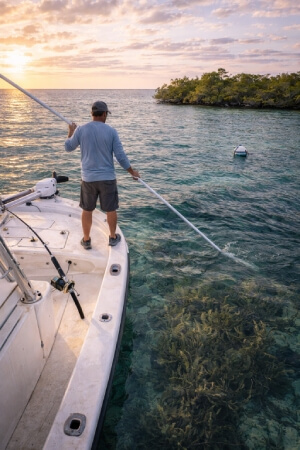
Drag a netted anchor across a bed of seagrass or coral, and you’ll be destroying a habitat that takes years or even decades to recover. If a buoy mooring is nearby, then use it rather than anchoring. In shallow flats, change out your outboard motor for a trolling motor or push pole. Be sure to avoid poling or wading right through a seagrass bed when you could just go around it.
This is definitely not just some abstract environmentalism – it’s actually looking after those areas that give you the best fishing. Your most productive inshore grounds rely on having an intact seagrass habitat themselves. If you damage it, the baitfish, shrimp and young fish that attract larger species there also vanish from it.
Discarded monofilament line is one of the major causes of fishing waste problems. It gets tangled around birds, sea turtles and marine mammals and remains in the environment itself for up to 600 years. You can recycle your monofilament in bins available at most marinas and boat ramps or through Berkley’s national recycling programme – be sure to do this.
Pack away the rest: bait packaging, hooks, your leader material and used line. And never dispose of unwanted bait – alive or dead – in waters you don’t know. This could bring in a disease and a non-native species, causing very severe and long-term damage to the local fishery.
Anglers are one of the primary vectors for spreading invasive aquatic species between bodies of water – quite often without even knowing it. Zebra mussels, hydrilla, and northern snakehead have all devastated their local fisheries, having been carried over on equipment. The damage is often irreparable.
The Clean, Drain, Dry protocol stops this:
Conservation and responsible angling aren’t quite in opposition to sport fishing itself – they’re what make it sustainable. Every angler who practices selective retention, follows size and bag limits, handles fish very carefully and looks after their habitat will be voting for the future of the sport.
The three pillars are simple: regulations exist since science demands them, your practice will be part of a huge group of anglers’ collective efforts, and our combined involvement will speed up the recovery process itself. Sustainable sport fishing and conservation aren’t ideals we’re hoping for – they are habits we should start building right now.
The fish being caught today can still be around for the next generation. This isn’t wishful thinking – the red snapper recovery actually showed us it is possible. It just requires carrying out responsible fishing practices consistently by enough people for long enough. You’re one of those people.