From the outside looking in, it may seem like some anglers are naturals at fishing because they always head home with a photo-worthy catch, while others have nothing to show for their hours in the water. But while it might seem like these anglers are just lucky or more knowledgeable, the truth is that success in sport fishing comes down to understanding the factors that affect fishing conditions and how these change from one season to another. Our guide explains everything you need to know so that you, too, can have a great catch no matter the weather.
Many people get the shock of their lives on their first fishing trips when they realize that fishing is more of a waiting game, and a quiet one at that. And they soon start contending with the fact that they have to sit in silence for hours on end as they patiently wait for fish to take the bait. But quietude is not the only factor that determines whether they catch anything. Instead, fishing conditions are influenced by the following aspects:
Fish, unlike humans, are unable to regulate their own body heat, and they thus rely on the surrounding water to determine their metabolic rates. When the water is cold, the fish reduce their activities so as to save energy, and this limits their movement and feeding. And when the water is too hot, then it is unable to hold a lot of oxygen, and fish adapt to this by moving less. Hot water also stresses the fish and prompts them to move to cooler regions.
But here is the catch, if you will. Fish are not the same. So, while some fish may move deeper into the water the minute the sun comes out, some species are able to thrive in those warm conditions. As such, you must understand the temperature range that best favors the species you want to catch, as this will inform you on when best to cast your line.
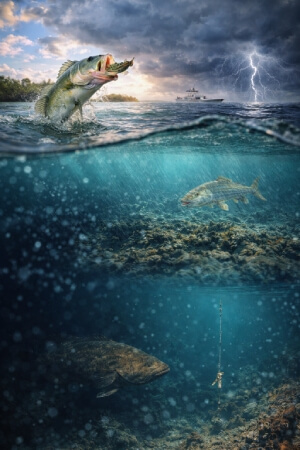
Have you ever wondered how fish are able to remain afloat all that time in the water? Well, their secret lies in having an air-filled swim bladder that keeps them buoyant. But this bladder does not just help them avoid sinking. It also plays a vital role in helping the fish sense when atmospheric pressure is about to change, such as right before a storm.
Here is how this plays out. When the atmospheric pressure starts falling, such as right before a storm, fish sense this and start feeding more in readiness for the weather change. Anglers take advantage of these feeding periods to catch fish as they come out in large numbers.
As soon as the low pressure hits, like during the storm, the fish move to deeper waters, as this helps them stabilize their swim bladders. And catching them at this time becomes an uphill task. Unfortunately, they remain hunkered down even after the low pressure lifts because this decreased atmospheric pressure is often replaced by high pressure. This increased pressure adds a weight to the atmosphere that makes the fish feel sluggish or uncomfortable, and they thus do not move much. As such, fishing becomes tough until the pressure evens out again, which can take time.
Here is a fun fact about fish – they do not have eyelids! What’s more, their pupils do not adjust like ours. And that means that if they are in the presence of a lot of light, they cannot adapt to the conditions easily, and they, therefore, move to more conducive conditions. But where do they go?
Well, on brighter days, fish tend to move to deeper water or find cover under docks, logs, weeds, and other surfaces that can protect them from the light. So, when anglers are fishing on such a day, they tend to focus on the shadows and deeper structures because most fish hide here.
You will also find that there are many cases when the light conditions are optimal for the fish. These include:
In these cases, the fish do not move away in search of low-lit conditions and are often near the surface of the water, even in the open water sections.
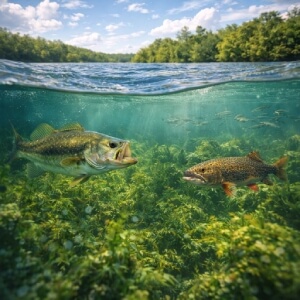
Now, here is something that humans and fish have in common – we both rely on oxygen to survive. And while fish live in water where oxygen is readily available, the levels are not always optimal or uniform across the entire water body. Factors such as currents, wind, and aquatic plants determine the oxygen levels, and thus the habitability of the water body.
Take stratified lakes as an example. Their bottom layers tend to be anoxic, and this makes it hard for the fish to survive, which is why you often find them in the upper layers.
As an angler, your best bet at catching fish lies in looking for water that is conducive to life. Think of aerated weed beds, moving streams of water, windy shores, and the like. These are more likely to have active fish than their stiller counterparts.
If you have ever cast your line and spent hours waiting to catch fish but none took your bait, your line might have been so obvious that the fish were able to avoid it time and again. But how can fish tell that they have an unwelcome guest? It all comes down to the visibility of the water.
You see, when fish are in clear water, they rely on their sight to gauge their surroundings. So, when you cast your fishing line, the fish are able to make it out, as well as the fake lure. But in muddy water, fish do not have the advantage of sight, and they instead rely on their lateral line, which can detect movements in the water.
The good news, though, is that you can use both types of visibility to your advantage with some planning. Say, for example, that you want to fish in clear water. In this case, you can use thin invisible lines with natural colors, like fluorocarbon, and the fish will be none the wiser. And if you are heading to muddy fishing spots, go for vibrating or rattling lures to attract the fish. Upping the ante with contrasting colors like black and blue is also a nice strategy.
Fish migrate in two ways – local and long-distance. In local migration, the fish move within the same body of water. However, with long-distance migration, fish travel across different water bodies. For example, salmon and striped bass often move between saltwater and freshwater bodies.
Local migration is affected by the factors discussed earlier, such as light and pressure, while long-distance migration comes down to factors such as spawning periods and changing temperatures. It is important to note that some species engage in both types of migration while others only move within the same body. Thus, knowing the type of species you want to catch and how they move is important when coming up with a fishing calendar.
Weather changes everything, not just in fashion trends but also in fishing. And if you do not know what’s happening in each season, it is easy to miss out on some of the opportunities that arise with these changes. So, what takes place each season?
Many anglers love the coming of spring because it signals the start of the spawning season, which is also referred to as the official mating season. During this period, the water warms and many freshwater species (such as bass, crappie, bluegill, and trout) come out of the woodwork to pave way for another generation of their kind.
The fish gradually move from the deeper zones into the shallows, where they focus on feeding and reproducing, and this happens in two stages. In the early spring, the fish focus more on feeding to regain their energy. With ice thawing and the rains stirring up nutrients, fish often head to these shallows in schools, creating the perfect fishing ground. Come mid-spring, the fish start spawning in the beds in the shallows. However, while the fish are often visible, they also tend to be very aggressive and territorial.
Given the aggressive behavior exhibited by fish during this time, anglers tend to use lures that match the local insects and baitfish, as these are more effective. Fishing in the spots that first get warmed by the sun is also a good idea. For example, if you are in the Northern Hemisphere, then you want to use the north-facing spots.
Spring is arguably the easiest time to fish in the shallows. But this ease comes to an end in the summer as the temperatures rise, pushing the fish to act in ways that are best described as a conundrum. On the one hand, the fish become more predictable in their behaviors, such that once the sun gets hot, they move to the deeper and cooler waters because the heat exhausts them. But on the other hand, they start becoming more creative in their hiding spots. And they start burying themselves in weed beds and other nooks and crannies that are hard to access.
Luckily, many anglers easily adapt to these new conditions. They start moving to the deeper zones or going heavy in the covers to find the fish during the day. Others choose to fish at night when predatory fish are known to move to the shallows in search of prey. Either way, the chances of success are high.
But if you really want the best chances, we advise you to use the wind. You see, you always want to set up on the windward shore, which is the shore that the wind is blowing toward. This way, as the cool and oxygen-rich surface water gets pushed towards you, so do the fish, which will follow suit because of the plankton!
When fall approaches, fish know that winter is coming. And just like bodybuilders who are bulking up for prep, the fish start eating more in preparation for the colder months, as well as migration. They even start following schools of baitfish to the shallows and other spots, like the minnows, in search of food. Thanks to this high appetite, catching them becomes quite easy. In fact, the bigger the lure, the easier it is to catch the fish because they go for the highest-calorie meals they can find.
But this ease does not last the entire season. Towards late fall, many water bodies go through a turnover where the cold surface water sinks to mix with the deep water. And as the fish readjust to the changing temperatures and water levels, their behaviors become less predictable, which puts a damper on fishing.
To maximize your catches before this turnover, keep an eye out for schooling fish, which are groups of fish that are hunting together. You can find these by focusing on spots where birds are diving into the water, as this is often a sign of predator fish in the water.
You may think that with the coming of the cold months, you cannot catch any fish. But that could not be further from the truth. It all comes down to understanding how the fish live during this season.
As we said before, fish depend on water to regulate their temperatures. And in the freezing cold, their metabolisms take a big hit such that they barely eat or move. And then tend to move towards the deepest and most stable parts of the water body where they can swim in place and conserve their energy. As a result, you have to move very close to them to the point of nudging them with the lures to get them to bite.
Now is the time to work with light lines and tiny lures. Also, you need to slow down and barely move so as to avoid spooking the fish while also allowing them enough time to take the bite. Since movement hinges on temperatures, fishing during the warmest parts of the day is best, as fish are more likely to feed during this time.