Charter fishing experiences continue to garner a lot of attention globally, not just from aspiring anglers but pros as well. If you are thinking of booking such an experience, it’s important to understand the options available and how they differ from going fishing by yourself without the crew. Our guide walks you through these varied experiences, thus making it easier for you to decide what feels like the best fit. Let’s get started.
The best way to categorize charter fishing experiences is by considering the different locations where the fishing takes place, the kind of booking options available, and the uniqueness of these excursions. As such, we will base our categories on these three pillars, as follows:
As you very well know, fishing can take place in different parts of a water body. The location chosen during a charter experience plays a vital role in determining how much energy you, as the angler, require to fish as well as the types of fish available to you. How so?
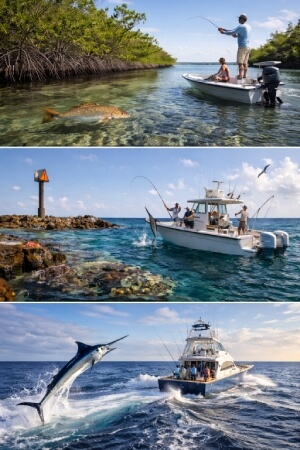
These charter experiences focus on the shallows with a special emphasis on spots like mangroves, tidal creeks, salt marshes, and other shallow places, where you can target species like Snook, Redfish, Bonefish, and Tarpon. In most of these cases, the boats sit on less than 10 feet of water. As such, you are able to see the fish tails and shadows before throwing the lure, which makes it quite easy to strategize. However, given the proximity to the fish and the high visibility in the water, you need to be quiet and tactical because while the fish may not be heavy, they are fast and can easily wrap your line around roots and other objects in the water as they try to get away from you. We recommend these types of experiences for people who are wary of going deep into the sea, families with children, anglers who want precise casting, and people who suffer from seasickness.
For these charters, the boats drive anything from 3 to 15 miles away from the shore so that you can access spots like artificial reefs, old shipwrecks, and other structures that harbor fish such as Snapper, Grouper, Amberjack, and King Mackerel. These boats are often quite big and fast, such that they can move to several spots within the same area on the same day, thus providing you with ample opportunities to catch fish. The fishing technique here, which hinges on the use of medium-heavy conventional reels, is simple. You drop a weighted line down, wait for the ‘thump’, and then reel in fast to keep the fish from heading back down to the structure. If you keep at it, you can head home with a huge pile of fish, provided you work fast and have the strength to keep up with several pounds worth of fish. We recommend these charters for people seeking the adventures of angling, as well as those who want to fill their freezers with edible fish.
With these charters driving over 20 miles out and some going as far as over 100 miles out, you get to fish in depths ranging from 100 to 2,000 feet. And as anyone will tell you, this opens you up to all sorts of fish, including Blue Marlin, Sailfish, Yellowfin Tuna, Mahi-Mahi, and Wahoo. Therefore, these are the best charter experiences for people who are eager to go home with big or rare catches. Since these boats often stay out in the water for days to weeks at a time, they are more of an all-inclusive package, and they come equipped with everything from bolted fishing chairs to bathrooms and cabins. Here, trolling is often the most effective way of catching the fish. The boats stay in gear while pulling a few lures or rigged baits at different depths and distances while the crew looks out for birds, floating debris, and other matter that indicate life. In most cases, it takes hours of silence before the team catches something, and then, it is all hands on deck as the team works together to reel in the catch.
Beyond distance, charter fishing experiences differ when it comes to how much fishing time you get as well as your relationship with the captain. And here, we can break down the options into two: the private charters and the shared charters.
When you book a private charter, you essentially own the boat for that period. So, it is up to you to decide whether you want to spend that time out in the sea or navigating the shallows. Better yet, you can change the plan and even go swimming with the dolphins if you decide you want a change of plans. And best of all, you decide who gets to be on board, which allows you to create an intimate fishing experience with your friends and family.
But the fun does not only come from being in control. You also get to have a dedicated team that works to help you get the catch you want, including a dedicated First Mate who ensures that your hook remains baited and your line is free of tangles. They also guide you on how to fish, and you get to walk away with angling tips that you can use for a lifetime.
As you would expect, these experiences attract a high fee, which is set based on the amount of time you use the boat rather than the number of people you bring with you.
In this case, the boat owner sets up the fishing trip and puts different people together on a private boat. The boat owner gets to decide the spots you visit, how long you stay in each spot, and the whole itinerary in general. They also get the final say on who stays on the boat and come up with the fishing and interaction rules.
Giving up this control to the boat owner comes with its perks. For one, you pay a fraction of the cost but still get to fish in a high-end boat. Secondly, you get to avoid the decision fatigue that comes with deciding what to do and can instead follow the directions of someone who has been there and done that. And third, you get to meet a ton of strangers, which opens you up to making new friends and a change of scene.
However, being in a shared charter has its downsides. Since there is one mate for every 5 to 10 people, the focus is often on the newbies, and if you have some fishing skills, you may be overlooked as the mate tries to help the person with fewer skills. And you get no say in how the trip unfolds.
At the final end of the spectrum, we have party boats. These are huge vessels that can carry anything from 30 to 60 people, where guests pay on a per-head basis. And truth be told, these are more like social events where the focus is on having fun rather than fishing itself. After all, with mates running around to untangle lines and help tens of people at once, the fishing is not very effective. But on the plus side, they are great for people looking to learn a thing or two about fishing while hanging out with other people in the sea.
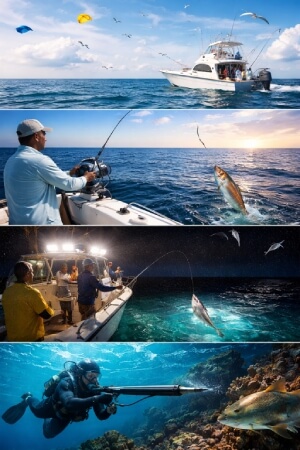
If you are the type of person who loves a challenge, it may do you well to look into specialty experiences, which often fall into the following groups:
So, if you have been there, done that, and are curious about what else is out there, you may want to try these options.
Given that you can buy fishing gear, hire a boat, and go out into the water without paying for a crew, why do people go for charter fishing experiences? Well, it comes down to the following aspects:
If you have ever fished on your own, you know that the chances of walking away with empty hands are quite high. After all, you must read the tide charts, map the water temperature, watch the birds, and so on. Else, you can miss the fish entirely. With charter experiences, you delegate all these activities to a crew that is out in the water for months on end every year. So, they know where the fish are and how to get to them, which greatly increases your success rate.
Charter experiences provide you with everything, from the high-end gear to the personalized help. They have your back with cutting bait, untangling lines, rigging the knots, and having everything set up for you such that you can just sit back and wait for the catch. And you do not even have to worry about cleaning or repairing the boat or gear after your fishing trip. But if you are doing it yourself, all this work falls on your shoulders.
One of the main reasons people choose charter experiences is that they can rely on the Captain to handle the logistics. It is the Captain’s job to keep track of the navigation, comply with the Coast Guard regulations, monitor the weather, and call for help or backup as necessary. Since all these activities are part of their protocols, they know what to do and have the comms for it. This coordination is unlike DIY fishing, where you must manage everything, including your safety, while also doing your best to catch fish.
Going on a charter fishing experience is the quickest way to improve your angling skills. The crew explains their techniques and tips in detail, which can shave off months of trial and error in the water. This way, you can skip the mistakes that often hinder successful fishing trips for new anglers and jump straight to the fun side of things.
Fishing crews not only have a license that covers everyone on the boat, but they also ensure that you only keep the fish that meet the current guidelines. But if you go out by yourself, you must research and pay for the necessary licenses while also keeping tabs on seasonal closures and size limits. Otherwise, you end up with hefty fines.
Of course, DIY fishing has its benefits, such as learning from your mistakes. But if you want to have the convenience of decades of expertise at your disposal while delegating the hard work to expert crews, charter experiences are your best bet.